Print failures and lessons
Failureisn'ttheoppositeofquality—it'sthepathtoit.
The elephant in the room
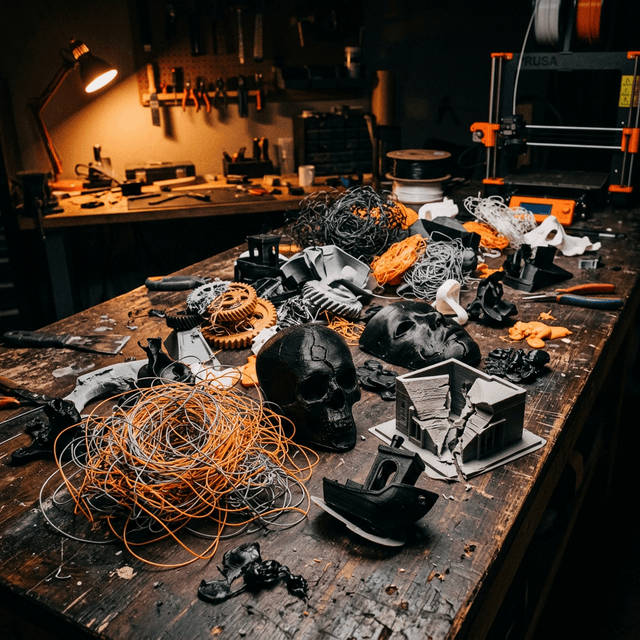
Let's talk about the elephant in the room: 3D printing fails. A lot. And when it fails, it fails spectacularly — spaghetti-like tangles of filament, delaminated layers, and objects that look like they melted in the sun.
The planter catastrophe
Our first major production failure was a batch of geometric planters. We'd tested the design five times successfully, but when we scaled to 20 pieces for a launch, overnight temperature drops caused 14 of them to crack. Lost three days of print time and a lot of filament.
Failure isn't the opposite of quality — it's the path to it.
That failure taught us about environmental control. We now monitor ambient temperature and humidity continuously. Our print room maintains a stable 24°C ± 1°, and we track conditions for every single print run.
The failure log
Another memorable failure: a custom chess set where the knight's head kept breaking off during support removal. The geometry was too delicate for FDM printing at that scale. We redesigned the model three times before finding a version where the support structures didn't compromise the detail.
We've learned that failure isn't the opposite of quality — it's the path to it. Every failed print teaches us something about materials science, mechanical engineering, and the limits of our technology. We now keep a 'failure log' that documents every significant failure and the lesson it taught us.
The products you see in our shop have survived this gauntlet. They work because dozens of earlier versions didn't. And we wouldn't have it any other way.